 Add to Chrome
 Add to Firefox
 Add to Edge
Cross-Modal Clinical Knowledge Integration for Mammography Report Generation
May 29, 2026
Breast cancer is a major global health concern, and mammography screening plays a central role in early detection. The large volume of screening examinations creates a substantial workload for radiologists, making accurate and consistent report generation a critical clinical challenge. Existing automated mammography report generation methods primarily focus on direct visual-to-text mapping, while overlooking the structured clinical reasoning process followed by radiologists in real-world practice. To address this limitation, we propose MammoRG, a mammography report generation framework that explicitly simulates the clinical reporting workflow by following the BI-RADS guideline and incorporating prior clinical knowledge to produce diagnostic reports. Specifically, MammoRG adopts a two-stage training framework. In the first stage, the model learns to integrate clinically relevant prior knowledge from a patient's four-view mammograms through classification-based supervision. In the second stage, a terminology-aware supervised fine-tuning strategy is introduced to model mammography-specific clinical terms as atomic semantic units, enabling the generation of high-quality reports with improved clinical consistency. To facilitate clinical efficacy evaluation of generated reports, we further develop MammoRGTool, a dedicated mammography report parsing tool that extracts structured clinical information from free-text reports. Extensive experiments demonstrate that MammoRG consistently outperforms existing methods across multiple clinical efficacy metrics, particularly in diagnosis-related BI-RADS F1, where it surpasses the second-best model by 2.73%, 2.04%, 1.90%, and 3.27% on the internal, external 1, external 2, and VinDr-Mammo datasets, respectively.

StreamMeCo: Long-Term Agent Memory Compression for Efficient Streaming Video Understanding
Apr 10, 2026Vision agent memory has shown remarkable effectiveness in streaming video understanding. However, storing such memory for videos incurs substantial memory overhead, leading to high costs in both storage and computation. To address this issue, we propose StreamMeCo, an efficient Stream Agent Memory Compression framework. Specifically, based on the connectivity of the memory graph, StreamMeCo introduces edge-free minmax sampling for the isolated nodes and an edge-aware weight pruning for connected nodes, evicting the redundant memory nodes while maintaining the accuracy. In addition, we introduce a time-decay memory retrieval mechanism to further eliminate the performance degradation caused by memory compression. Extensive experiments on three challenging benchmark datasets (M3-Bench-robot, M3-Bench-web and Video-MME-Long) demonstrate that under 70% memory graph compression, StreamMeCo achieves a 1.87* speedup in memory retrieval while delivering an average accuracy improvement of 1.0%. Our code is available at https://github.com/Celina-love-sweet/StreamMeCo.
ShareVerse: Multi-Agent Consistent Video Generation for Shared World Modeling
Mar 03, 2026This paper presents ShareVerse, a video generation framework enabling multi-agent shared world modeling, addressing the gap in existing works that lack support for unified shared world construction with multi-agent interaction. ShareVerse leverages the generation capability of large video models and integrates three key innovations: 1) A dataset for large-scale multi-agent interactive world modeling is built on the CARLA simulation platform, featuring diverse scenes, weather conditions, and interactive trajectories with paired multi-view videos (front/ rear/ left/ right views per agent) and camera data. 2) We propose a spatial concatenation strategy for four-view videos of independent agents to model a broader environment and to ensure internal multi-view geometric consistency. 3) We integrate cross-agent attention blocks into the pretrained video model, which enable interactive transmission of spatial-temporal information across agents, guaranteeing shared world consistency in overlapping regions and reasonable generation in non-overlapping regions. ShareVerse, which supports 49-frame large-scale video generation, accurately perceives the position of dynamic agents and achieves consistent shared world modeling.
Advancing Open-source World Models
Jan 28, 2026We present LingBot-World, an open-sourced world simulator stemming from video generation. Positioned as a top-tier world model, LingBot-World offers the following features. (1) It maintains high fidelity and robust dynamics in a broad spectrum of environments, including realism, scientific contexts, cartoon styles, and beyond. (2) It enables a minute-level horizon while preserving contextual consistency over time, which is also known as "long-term memory". (3) It supports real-time interactivity, achieving a latency of under 1 second when producing 16 frames per second. We provide public access to the code and model in an effort to narrow the divide between open-source and closed-source technologies. We believe our release will empower the community with practical applications across areas like content creation, gaming, and robot learning.
Beyond Pixels: Semantic-aware Typographic Attack for Geo-Privacy Protection
Nov 16, 2025Large Visual Language Models (LVLMs) now pose a serious yet overlooked privacy threat, as they can infer a social media user's geolocation directly from shared images, leading to unintended privacy leakage. While adversarial image perturbations provide a potential direction for geo-privacy protection, they require relatively strong distortions to be effective against LVLMs, which noticeably degrade visual quality and diminish an image's value for sharing. To overcome this limitation, we identify typographical attacks as a promising direction for protecting geo-privacy by adding text extension outside the visual content. We further investigate which textual semantics are effective in disrupting geolocation inference and design a two-stage, semantics-aware typographical attack that generates deceptive text to protect user privacy. Extensive experiments across three datasets demonstrate that our approach significantly reduces geolocation prediction accuracy of five state-of-the-art commercial LVLMs, establishing a practical and visually-preserving protection strategy against emerging geo-privacy threats.
Concept Guided Co-saliency Objection Detection
Dec 21, 2024The task of co-saliency object detection (Co-SOD) seeks to identify common, salient objects across a collection of images by examining shared visual features. However, traditional Co-SOD methods often encounter limitations when faced with diverse object variations (e.g., different postures) and irrelevant background elements that introduce noise. To address these challenges, we propose ConceptCoSOD, a novel concept-guided approach that leverages text semantic information to enhance Co-SOD performance by guiding the model to focus on consistent object features. Through rethinking Co-SOD as an (image-text)-to-image task instead of an image-to-image task, ConceptCoSOD first captures shared semantic concepts within an image group and then uses them as guidance for precise object segmentation in complex scenarios. Experimental results on three benchmark datasets and six corruptions reveal that ConceptCoSOD significantly improves detection accuracy, especially in challenging settings with considerable background distractions and object variability.
CosalPure: Learning Concept from Group Images for Robust Co-Saliency Detection
Mar 27, 2024Co-salient object detection (CoSOD) aims to identify the common and salient (usually in the foreground) regions across a given group of images. Although achieving significant progress, state-of-the-art CoSODs could be easily affected by some adversarial perturbations, leading to substantial accuracy reduction. The adversarial perturbations can mislead CoSODs but do not change the high-level semantic information (e.g., concept) of the co-salient objects. In this paper, we propose a novel robustness enhancement framework by first learning the concept of the co-salient objects based on the input group images and then leveraging this concept to purify adversarial perturbations, which are subsequently fed to CoSODs for robustness enhancement. Specifically, we propose CosalPure containing two modules, i.e., group-image concept learning and concept-guided diffusion purification. For the first module, we adopt a pre-trained text-to-image diffusion model to learn the concept of co-salient objects within group images where the learned concept is robust to adversarial examples. For the second module, we map the adversarial image to the latent space and then perform diffusion generation by embedding the learned concept into the noise prediction function as an extra condition. Our method can effectively alleviate the influence of the SOTA adversarial attack containing different adversarial patterns, including exposure and noise. The extensive results demonstrate that our method could enhance the robustness of CoSODs significantly.
Edge-aware Hard Clustering Graph Pooling for Brain Imaging Data
Sep 13, 2023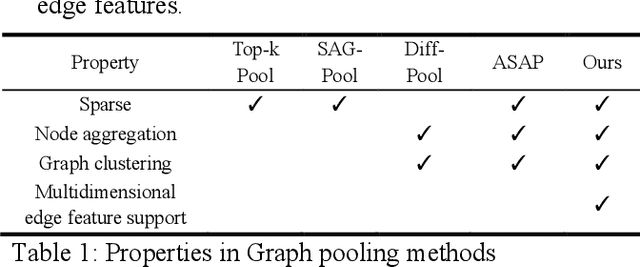

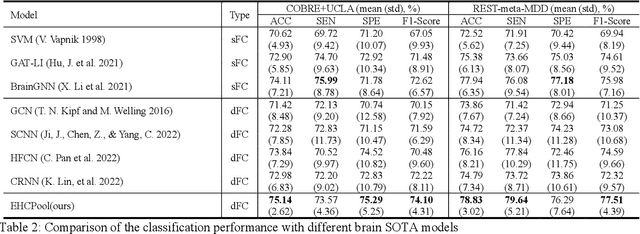

Graph Convolutional Networks (GCNs) can capture non-Euclidean spatial dependence between different brain regions, and the graph pooling operator in GCNs is key to enhancing the representation learning capability and acquiring abnormal brain maps. However, the majority of existing research designs graph pooling operators only from the perspective of nodes while disregarding the original edge features, in a way that not only confines graph pooling application scenarios, but also diminishes its ability to capture critical substructures. In this study, a clustering graph pooling method that first supports multidimensional edge features, called Edge-aware hard clustering graph pooling (EHCPool), is developed. EHCPool proposes the first 'Edge-to-node' score evaluation criterion based on edge features to assess node feature significance. To more effectively capture the critical subgraphs, a novel Iteration n-top strategy is further designed to adaptively learn sparse hard clustering assignments for graphs. Subsequently, an innovative N-E Aggregation strategy is presented to aggregate node and edge feature information in each independent subgraph. The proposed model was evaluated on multi-site brain imaging public datasets and yielded state-of-the-art performance. We believe this method is the first deep learning tool with the potential to probe different types of abnormal functional brain networks from data-driven perspective. Core code is at: https://github.com/swfen/EHCPool.
DC-Net: Divide-and-Conquer for Salient Object Detection
May 24, 2023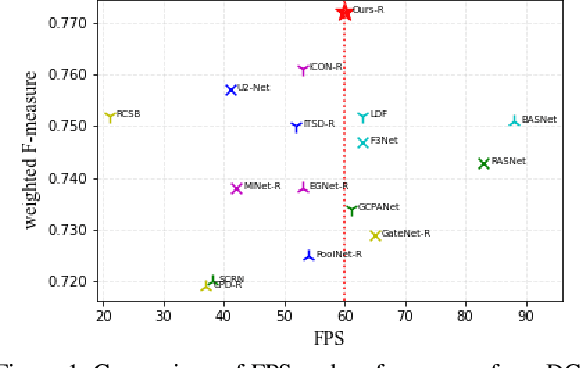
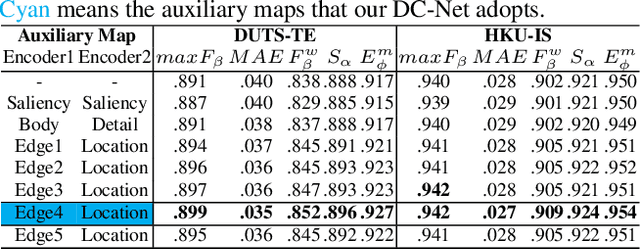
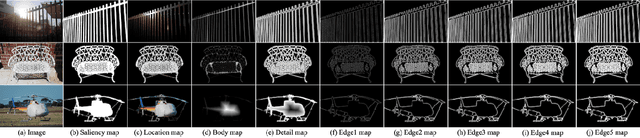
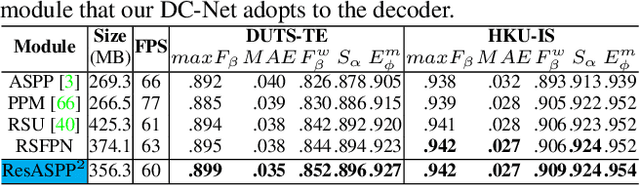
In this paper, we introduce Divide-and-Conquer into the salient object detection (SOD) task to enable the model to learn prior knowledge that is for predicting the saliency map. We design a novel network, Divide-and-Conquer Network (DC-Net) which uses two encoders to solve different subtasks that are conducive to predicting the final saliency map, here is to predict the edge maps with width 4 and location maps of salient objects and then aggregate the feature maps with different semantic information into the decoder to predict the final saliency map. The decoder of DC-Net consists of our newly designed two-level Residual nested-ASPP (ResASPP$^{2}$) modules, which have the ability to capture a large number of different scale features with a small number of convolution operations and have the advantages of maintaining high resolution all the time and being able to obtain a large and compact effective receptive field (ERF). Based on the advantage of Divide-and-Conquer's parallel computing, we use Parallel Acceleration to speed up DC-Net, allowing it to achieve competitive performance on six LR-SOD and five HR-SOD datasets under high efficiency (60 FPS and 55 FPS). Codes and results are available: https://github.com/PiggyJerry/DC-Net.
Temporal Dynamic Synchronous Functional Brain Network for Schizophrenia Diagnosis and Lateralization Analysis
Apr 06, 2023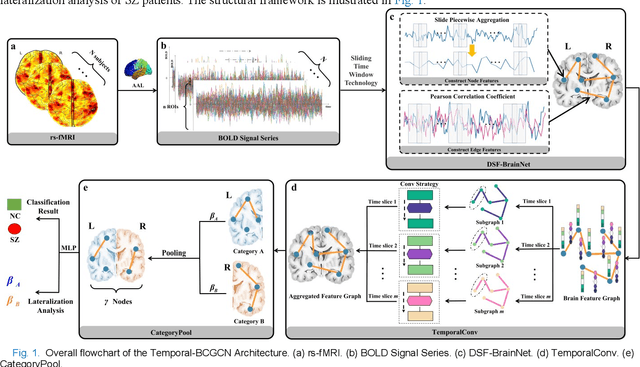
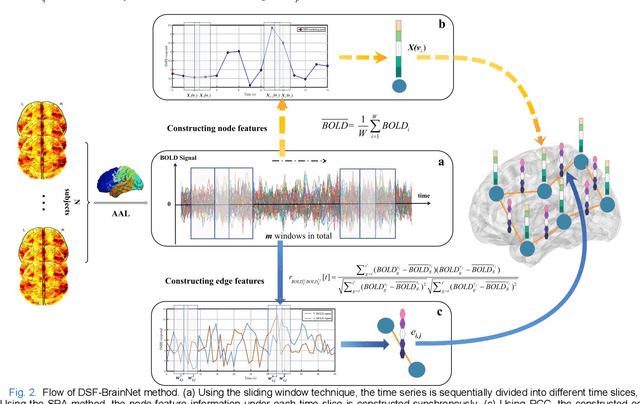
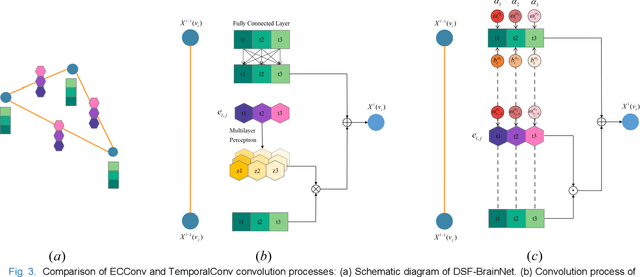
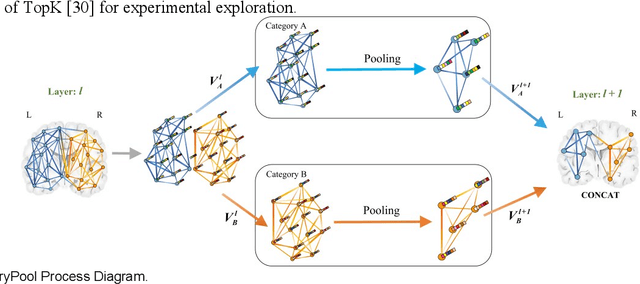
The available evidence suggests that dynamic functional connectivity (dFC) can capture time-varying abnormalities in brain activity in resting-state cerebral functional magnetic resonance imaging (rs-fMRI) data and has a natural advantage in uncovering mechanisms of abnormal brain activity in schizophrenia(SZ) patients. Hence, an advanced dynamic brain network analysis model called the temporal brain category graph convolutional network (Temporal-BCGCN) was employed. Firstly, a unique dynamic brain network analysis module, DSF-BrainNet, was designed to construct dynamic synchronization features. Subsequently, a revolutionary graph convolution method, TemporalConv, was proposed, based on the synchronous temporal properties of feature. Finally, the first modular abnormal hemispherical lateralization test tool in deep learning based on rs-fMRI data, named CategoryPool, was proposed. This study was validated on COBRE and UCLA datasets and achieved 83.62% and 89.71% average accuracies, respectively, outperforming the baseline model and other state-of-the-art methods. The ablation results also demonstrate the advantages of TemporalConv over the traditional edge feature graph convolution approach and the improvement of CategoryPool over the classical graph pooling approach. Interestingly, this study showed that the lower order perceptual system and higher order network regions in the left hemisphere are more severely dysfunctional than in the right hemisphere in SZ and reaffirms the importance of the left medial superior frontal gyrus in SZ. Our core code is available at: https://github.com/swfen/Temporal-BCGCN.